


Exhaust Catalytic Converter
Your Professional Exhaust Catalytic Converter Manufacturer & Supplier
Founded in 2010, Jiangxi CAS Kerry Pro-enviroment Catalyst Co. , Ltd is a tech-driven enterprise specializing in R&D and production of eco-friendly catalysts. Boasting a 13,000㎡ R&D and manufacturing base, we offer diverse catalysts for waste incineration, VOCs removal, exhaust purification, etc., plus custom solutions.


Why Choose Us
Professional Team
The company has 51 employees, including 18 R&D engineers, among whom are 3 PhDs and 10 senior technical experts, forming a strong and experienced technical team.
Certifications & Achievements
We hold 1 national invention patent and 6 utility model patents, along with national and provincial key new product certifications. The company has also undertaken national and provincial innovation projects and received multiple science and technology awards at provincial and municipal levels, demonstrating strong R&D capability and industry recognition.
Customization Services
In addition to standard catalyst products, we provide tailored solutions based on specific client requirements, including size, performance, and application conditions, ensuring optimized solutions for different industrial needs.
Advanced Production Equipment
Equipped with mesh belt resistance furnaces, electric reduction furnaces, a 7230G spectrophotometer, and intelligent drying systems, we maintain precise production control and consistent product quality to ensure reliable catalyst performance.
Specification
|
Item |
Specification |
|
Product Name |
Exhaust Catalytic Converter |
|
Application |
Sport cars / High-performance vehicles |
|
Substrate Type |
Ceramic or metallic honeycomb |
|
Cell Density (CPSI) |
100–400 CPSI |
|
Catalyst |
Platinum / Palladium / Rhodium coating |
|
Housing Material |
Stainless steel (SS304 / SS409) |
|
Inlet/Outlet Size |
Customizable (2.0"–4.0") |
|
Operating Temperature |
200°C – 900°C |
|
Function |
Reduces CO, HC, NOx emissions |
|
Flow Design |
High-flow, low back pressure |
|
Installation |
Weld-on or clamp-on type |
|
Customization |
Size and structure available |
Advantages of Exhaust Catalytic Converter
Cleaner Air for Everyone: Exhaust catalytic converters are environmental superheroes. The process ensures that harmful pollutants are converted into less harmful substances. This significantly reduces air pollution, protecting the health of everyone, especially those vulnerable to respiratory issues.
Compliance with Emission Regulations: Exhaust catalytic converters aren't just for your lungs; they're also for the regulations! Governments worldwide have strict emission standards for vehicles, and these trusty devices ensure cars meet those targets.
Improved Fuel Efficiency: Turns out cleaner emissions also mean a bit more bang for your buck! Exhaust catalytic converters optimize engine combustion, leading to more efficient fuel usage.
Extended Engine Life: Those harmful pollutants the converter neutralizes can be tough on car engines. By removing them from the equation, the converter reduces wear and tear on internal components, potentially extending your engine's lifespan.

Two-way: They only have oxidation catalysts, which help change carbon monoxide to carbon dioxide. Hydrocarbons (which is unburned and partially burned fuel) are changed to carbon dioxide and water.
Three-way: This performs the same as the two-way converter with the addition of a reduction catalyst. This is used to change nitrogen oxides to nitrogen and oxygen gases.
Materials of Metric Roller Chain Sprocket
Stainless Steel Body
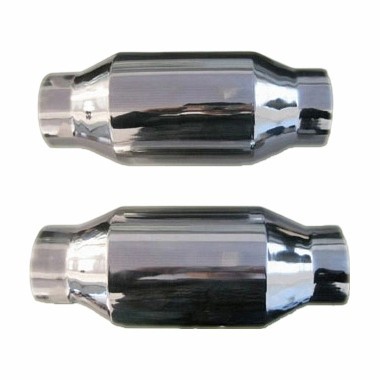
Engineered for long life and durability. The ribbed body minimizes expansion and distortion, as well as forming pockets that protect the cushioning mat from direct exposure to exhaust gases.
Monolithic Free-Flowing Substrate
The substrates are the backbone of the converter. This is where the proprietary mix of precious metals and the washcoat allow the conversion process to take place. Coatings are engineered for high temperature durability and optimal catalytic activity, as well as OBD system compatibility. Converters are available in single- or multiple-substrate designs.
Catalyst Cushioning Mat
The mat cushions the converter substrate, holding the ceramic catalyst in proper alignment and accommodating for thermal expansion of the body.
O2 (Oxygen) Sensor Ports
Another vital part of an emissions control system, these sensors are placed before and after the catalytic converter on an OBDII vehicle. They are designed to monitor the O2 levels in the exhaust gas and are also used to evaluate the status of the converter. This information along with data provided by the mass air flow, MAP (manifold absolute pressure) and engine sensors, allow the PCM to adjust fuel controls.
Precious Metals/Catalysts
The precious metals introduced onto the substrate serve as catalysts that chemically process raw exhaust gases. Those most commonly used are platinum (Pt), palladium (Pd) and rhodium (Rh).
Exhaust is first collected by the manifold and then pushed through pipes to the catalytic converter. At the heart of the catalytic converter is ceramic substrate, which is coated with a high surface area washcoat containing a precious metal coating. The coated ceramic heats quickly, helping neutralize the toxic mix of gaseous pollutants like hydrocarbons, nitrogen oxides and carbon monoxide. Inside the substrate, thousands of channels act as a chemistry lab, effectively treating the large volume of exhaust that flows through.
Ceramic particulate filter addresses microscopic particulate emissions. The filter design traps particulates in the inlet channels on the porous wall by forcing the exhaust through the finely engineered porous microstructure, allowing the clean exhaust to exit from the open outlet channel. The system is designed to periodically clean the filter by burning off built-up soot.
The neutralized gases are then led through a muffler to silence the engine sound before exiting the vehicle through the tailpipe.

Customization Services
To better meet the diverse needs of different industries and applications, we provide customized industrial catalytic converters based on specific operating conditions, equipment type, exhaust gas composition, and performance requirements. For more information or support, please feel free to contact us.
Packaging and Shipping
|
Packaging |
Export-grade cardboard boxes or wooden crates |
|
Transportation methods |
Sea, Air, and Land Transport |
Our Certificate


We're well-known as one of the leading exhaust catalytic converter manufacturers and suppliers in China. With over 15 years' experience, we warmly welcome you to buy high quality exhaust catalytic converter made in China here from our factory. Customized orders are welcome.
Honeycomb Ceramic Catalytic Converter CNG Catalyst, CNG Catalytic Converter, Sport Racing metallic exhaust catalytic converter