


Industrial Catalytic Converters
Your Professional Industrial Catalytic Converters Manufacturer & Supplier
Founded in 2010, Jiangxi CAS Kerry Pro-enviroment Catalyst Co. , Ltd is a tech-driven enterprise specializing in R&D and production of eco-friendly catalysts. Boasting a 13,000㎡ R&D and manufacturing base, we offer diverse catalysts for waste incineration, VOCs removal, exhaust purification, etc., plus custom solutions.


Why Choose Us
Professional Team
The company has 51 employees, including 18 R&D engineers, among whom are 3 PhDs and 10 senior technical experts, forming a strong and experienced technical team.
Certifications & Achievements
We hold 1 national invention patent and 6 utility model patents, along with national and provincial key new product certifications. The company has also undertaken national and provincial innovation projects and received multiple science and technology awards at provincial and municipal levels, demonstrating strong R&D capability and industry recognition.
Customization Services
In addition to standard catalyst products, we provide tailored solutions based on specific client requirements, including size, performance, and application conditions, ensuring optimized solutions for different industrial needs.
Advanced Production Equipment
Equipped with mesh belt resistance furnaces, electric reduction furnaces, a 7230G spectrophotometer, and intelligent drying systems, we maintain precise production control and consistent product quality to ensure reliable catalyst performance.
Specification
|
OE code |
Performance |
Old and new |
New |
|
Warranty service |
2 years |
Country of origin |
Jiangxi , china |
|
Application models |
Wood stove |
Use |
Origin replacement |
|
Size |
As customer's requirement |
Brand |
CAS kerry |
|
Emission stand |
Euro2, 3, 4 |
Shell material |
Stainless steel |
Advantages of Industrial Catalytic Converters
High Thermal Stability
Ceramic materials like cordierite can handle high temperatures. They do not break down easily. This makes the catalyst last longer and remains effective.
01
Large Surface Area
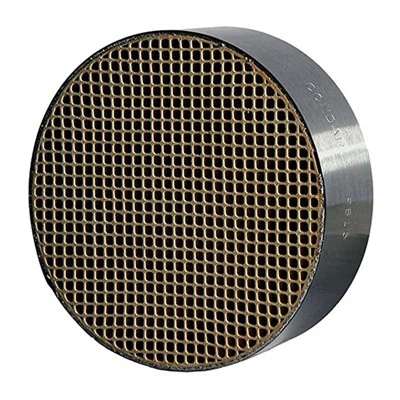
The honeycomb design increases the surface area. This helps with more efficient pollutant conversion. The catalytic material is spread out evenly, so exhaust gases are fully treated.
02
Low Pressure Drop
The open honeycomb structure allows exhaust gases to flow smoothly. There is little resistance, so the engine does not experience much back pressure. This helps the engine stay efficient and prevents power loss.
03
Durability and Strength
Industrial catalytic converters resist thermal shock. They also handle mechanical stress well. These catalysts are strong enough for tough conditions in cars and industries. They can handle repeated heating and cooling without cracking.
04
Environmental Impact
Industrial catalytic converters reduce harmful emissions. This helps create cleaner air. They lower pollutants and improve air quality. These catalysts also help meet strict environmental regulations.
05

A industrial catalytic converter (TWC) simultaneously removes three main compounds using reduction and oxidation reactions:
Reduction of nitrogen oxides (NOx) to nitrogen – NOx may be nitrous oxide (NO) or nitrogen dioxide (NO2) gases which create smog and acid rain.
Oxidation of carbon monoxide (CO) into carbon dioxide. Carbon monoxide is formed as fuel is combusted. It is a poisonous gas which can be lethal if inhaled.
Oxidation of unburnt hydrocarbons (HC) into carbon dioxide and water. Hydrocarbons are harmful and can also create smog.
Types of Industrial Catalytic Converters
Three-Way Catalytic Converter (Gasoline engine)
The catalytic converters used today are called three-way catalytic converters because they can convert three different exhaust gases (carbon monoxide, hydrocarbons and nitro oxide) to harmless. Unleaded fuel should be used, otherwise the lead will stick to the surface and block the holes.
Catalysts that accelerate chemical reactions in the catalytic converter are Platinum, Palladium, Iridium and Rhodium. Owing to platinum and rhodium, the emission of nitro oxide chemical into the air is prevented. The operating temperature is between 400 and 500 ° C.
Diesel Oxidation Catalyst (DOC) (Diesel engine)
The catalytic converter used in diesel engines is called Diesel Oxidation Catalyst. This type of catalytic converter is called a two-way catalytic converter. Because they cannot remove nitrous oxide from the exhaust. For this reason, two methods are used to reduce nitrogen oxide emission in diesel engines. These are EGR system and SCR systems.
In diesel oxidation catalyst, as catalyst; platinum, palladium and aluminum oxide are used. It's purpose is to react unburned carbon and carbon monoxide in vehicles with platinum and aluminum oxides and then combine them.By this way, harmful gases are converted into harmless.
Nitrogen Oxide Storage Catalyst (Diesel-Gasoline)
Conventional three-way catalytic converters fail to reduce nitrogen oxide emissions. For this reason, an Nitrogen oxide storage catalyst is additionally used in the exhaust system. In some diesel vehicles, the catalyst with Nitrogen oxide storage can be in the same box as the diesel particulate filter.
The aim of the nitrogen oxide covered catalyst is to store nitrogen dioxide (NO2). It's structure is just like oxidation catalyst.
Industrial Catalytic Converters Materials
Alumina Ceramics
Alumina is the most commonly used advanced ceramic material due to its strong ionic inter-atomic bonding. It provides excellent chemical and thermal stability, good strength, and both thermal and electrical insulation properties at a reasonable cost. With a range of purities and relatively low production costs, alumina is widely used across various industries.
Mullite Ceramics
Mullite forms only at high-temperature, low-pressure conditions and is typically supplied synthetically. Known for its low thermal expansion, excellent creep resistance, and stability under harsh chemical conditions, mullite is a strong candidate for advanced ceramics, particularly in industrial processes requiring high-temperature strength and stability.
Dense Alumina & Dense Cordierite
• Low water absorption (0-5%)
• High density and high heat capacity
• Large specific surface area, improving thermal efficiency
• Strong resistance to acids, silica, and salts, with low block rate
Silicon Carbide Ceramics
Silicon carbide is valued for its extreme hardness, high melting point, and excellent thermal conductivity. It retains its strength at temperatures up to 1400°C and is well-known for its wear and thermal shock resistance. Silicon carbide is widely used in industries for catalyst supports and filters in hot gas or molten metal applications due to its low thermal expansion coefficient and strong mechanical and chemical stability in high-temperature environments.
Cordierite Ceramics
Cordierite offers superior thermal shock resistance thanks to its low coefficient of thermal expansion (CET). It also has high refractoriness and chemical stability, making it ideal for high-temperature industrial applications, such as heat exchangers for gas turbines and honeycomb catalyst carriers in automotive exhaust systems.
Zirconia Oxide Ceramics
Zirconia is known for its high strength and toughness, especially when enhanced with additives such as magnesium oxide (MgO), yttrium oxide (Y2O3), or calcium oxide (CaO). These additives control phase transformation and improve wear and corrosion resistance, making zirconia ideal for applications requiring wear tolerance and resistance to damage in extreme conditions.
Corundum Ceramics
• High purity: Al2O3 > 99%, excellent chemical resistance
• Temperature resistance: Long-term use at 1600°C, short-term at 1800°C
• Thermal shock resistance and good resistance to cracking
• Slip casting, high density, and high-purity alumina
Other High-Temperature Ceramic Materials
Materials such as molybdenum, tungsten, and other metal oxides are used for applications in extreme temperature conditions.
Industrial catalytic converters are used mainly in automotive catalytic converters. Almost every modern vehicle with an internal combustion engine has these catalysts. They help vehicles meet emission standards. These catalysts are crucial for reducing emissions of carbon monoxide (CO), nitrogen oxides (NOx), and hydrocarbons. This applies to both gasoline and diesel engines.
Industrial catalytic converters are also used in industrial emission control systems. Industries like power plants, chemical manufacturing, and waste incineration produce a lot of exhaust gases. These industries use industrial catalytic converters to lower their environmental impact. In these settings, the catalysts help reduce pollutants. These pollutants include volatile organic compounds (VOCs), particulate matter, and sulfur oxides (SOx).

Customization Services
To better meet the diverse needs of different industries and applications, we provide customized industrial catalytic converters based on specific operating conditions, equipment type, exhaust gas composition, and performance requirements. For more information or support, please feel free to contact us.
Packaging and Shipping
|
Packaging |
Export-grade cardboard boxes or wooden crates |
|
Transportation methods |
Sea, Air, and Land Transport |
Our Certificate


We're well-known as one of the leading industrial catalytic converters manufacturers and suppliers in China. With over 15 years' experience, we warmly welcome you to buy high quality industrial catalytic converters made in China here from our factory. Customized orders are welcome.
enamelling machine ceramic catalytic converter, waste gas purification catalytic converter, Organic Waste Incineration Ceramic Catalytic Converter